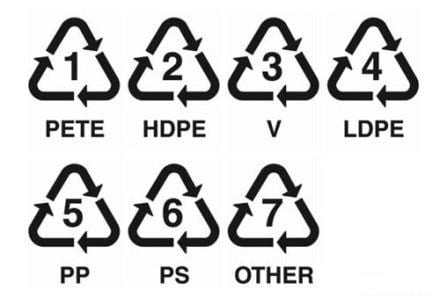
The plastic recycling mark is like an ID card for a plastic container. A small triangle symbol is usually engraved on the bottom of the plastic container. The numbers in the triangular frame range from 1 to 7, and each number represents a type of plastic container with completely different meanings.
01" Throw it away after drinking it
"01" represents PET (polyethylene terephthalate), which is commonly used in the production of bottled beverages such as mineral water and carbonated drinks. As we all know, beverage bottles made of this material cannot hold hot water and are only suitable for holding warm or frozen drinks. If they are filled with high-temperature liquids or heated, they will easily deform and dissolve harmful substances to the human body. Scientists also found that this plastic product may release carcinogens after being used for more than 10 months. Therefore, it is recommended that you throw away the finished beverage bottles and do not use them as water cups or storage containers. To avoid causing harm to health, the gain outweighs the loss.
“02” is not recommended as a water container
"02" stands for HDPE (high-density polyethylene). Plastic containers containing cleaning supplies and bath products or plastic bags commonly used in shopping malls are mostly made of this material. It can withstand high temperatures of 110°C and can be used to hold food if it is marked for food. Plastic containers containing cleaning supplies and bath products can be reused after careful cleaning, but they are often difficult to clean and leave residue behind, thus becoming a breeding ground for bacteria. As mentioned in the post, unlike other beverage bottles, the bottom of the 4L Nongfu Spring bottle is marked 02. Although it looks much stronger than ordinary mineral water bottles, it is not recommended to be used as a water container. Long-term use is very likely to produce harmful substances.
"03" Never let it get heated
"03" represents PVC (polyvinyl chloride), which is commonly found in raincoats and plastic films. Plastic products made of this material are prone to produce two toxic and harmful substances: one is single-molecule vinyl chloride that is not fully polymerized during the production process, and the other is harmful substances in plasticizers. These two substances are easy to precipitate when encountering high temperatures and grease. If they accidentally enter the human body, they can easily cause cancer. Therefore, it is rarely used in food packaging. If you happen to encounter it, do not let it get heated.
"04" exceeds 110℃
There will be thermal melting
"04" refers to LDPE (low-density polyethylene), the raw material of cling film and plastic film, and its heat resistance is not strong. Qualified PE cling film will melt when the temperature exceeds 110°C, leaving some plastic preparations that cannot be decomposed by the human body. And if it is wrapped outside the food and heated at the same time, the fat in the food will more easily dissolve the harmful substances in the plastic wrap.
"05" can be reused after careful cleaning
"05" stands for PP (polypropylene), which is the only material that can be heated in a microwave oven, so it has become a raw material for making microwave lunch boxes. It is resistant to high temperatures of 130°C, has a melting point as high as 167°C, and has poor transparency. It can be reused after careful cleaning. It should be noted that some microwave lunch boxes are made of No. 05 PP (polypropylene) for the box body, but the lid is made of No. 06 PS (polystyrene). PS has good transparency, but is not resistant to high temperatures, so it cannot be put into the microwave oven together with the box body. Before heating the lunch box in the future, don’t forget to take off the lid first.
"06" Avoid direct heating
Bowl box of instant noodles
"06" means PS (polystyrene), which is the material used to make bowl-type instant noodle boxes and foam fast food boxes. It cannot be used to hold strong acids (such as orange juice) or strong alkaline substances, because it will decompose polystyrene (carcinogen) that is not good for the human body. Although it is heat-resistant and cold-resistant, chemicals will be released due to excessive temperature. Therefore, do not heat the bowl of instant noodles directly in the microwave!
"07" use with caution
You can avoid "Bisphenol A"
"07" stands for PC and other types of PC. It is a material that is widely used and is mostly used to make baby bottles, space cups, etc. It is controversial because it contains toxic bisphenol A. Theoretically, as long as bisphenol A is 100% converted into a plastic structure during the production of PC, it means that the product does not contain bisphenol A at all, let alone releases it. However, no manufacturer can guarantee that bisphenol A has been completely converted, so you need to pay attention during use.
The higher the temperature, the more bisphenol A is released and the faster it is released. If you happen to have a plastic product numbered 07 in your hand, you can use the following methods to avoid it: do not heat it when using it, and do not expose it to direct sunlight; do not clean the kettle in a dishwasher or dishdryer; before using it for the first time, wash it with baking soda powder and warm water, and dry it naturally at room temperature; if the container is dropped or damaged in any way, stop using it immediately, because if there are fine pits on the surface of the plastic product, it is easy to harbor bacteria; avoid repeated use of aged plastic utensils.
Expert advice
In daily life, it is very common for beverage bottles and mineral water bottles to be used repeatedly. Many consumers often like to keep their used beverage bottles and mineral water bottles, and then fill them with tea or drinking water when they go out next time. They call this "environmental protection" and "saving". Experts said that qualified beverage bottles and mineral water bottles are required to be made of food-grade plastic, that is, PET bottles. These food-grade PET bottles cannot withstand high temperatures and need to be used at low temperatures. They are generally safe to use below 70 degrees Celsius. In addition, these plastic bottles are single-use, and the state stipulates that companies cannot recycle or refill them.
Plasticizers are added to plastic bottles during the production process, and this chemical component is toxic to the human body. If plastic bottles are used to fill drinking water, oil, wine and other substances for a long time, the harmful substances inside will easily dissolve and be brought into the human body. He suggested that it is relatively safer to use bottles made of glass, stainless steel and other materials to store food.
Tags
- Global News