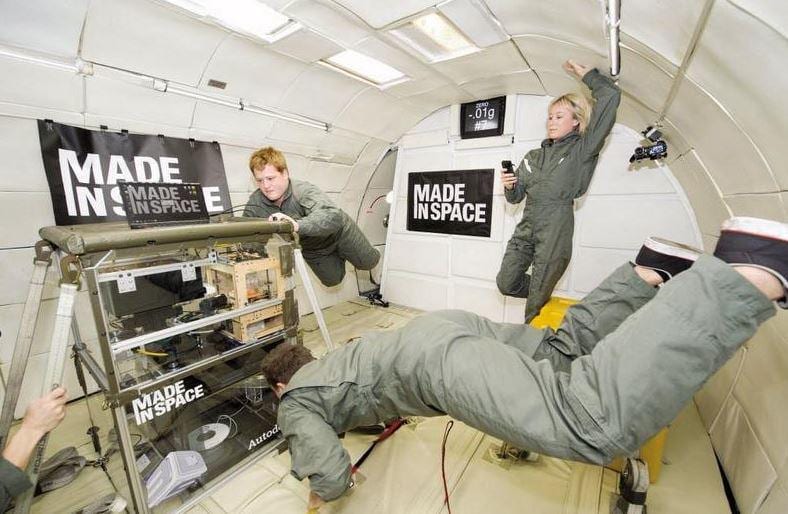
3D printing is not only struggling to enter mainstream applications on earth, but also leaving the earth and entering outer space.
Astronauts are taking 3D printing by storm on the International Space Station. If NASA's additive manufacturing project goes as planned, it won't be long before production is more complex and exciting than making wrenches and spare parts in space.
The first object 3D printed in space was a spare part for the 3D printer itself. It's an extruder housing with the printer manufacturer's name "Made In Space" and the NASA logo printed on it. This was quickly followed by printing a side panel for the extruder housing.
Niki Werkheiser, NASA's 3D printing program manager, said that when printing for the first time, "the artifact needs to make sense and be able to get test data from it."
"This kind of thing may seem boring to ordinary people. But this is the first time we have heated and extruded plastic in space. Even if it failed completely and printed a mess (which we know it won't), we would not understand it if we had not tried it while floating in the space station. The space station is the only laboratory platform that can provide microgravity."
Since the first successful print on November 24, the astronauts have tried bigger, better, and more recognizable objects, including a ratchet wrench. The drawings of the ratchet wrench were designed within a week, sent into space after approval, and took about four hours to print out. The consumable material was ABS 7006 filament. This is a true test of NASA’s on-demand 3D printing capabilities.
The 3D printing project is a $1.4 million Small Business Innovation R&D Program contract between NASA and California-based Made In Space. The first phase is to test the feasibility of astronauts producing parts and tools for their own use in a microgravity environment.
Bringing additive manufacturing technology into space will eventually greatly reduce the need to carry parts and tools from the earth into space, save the high cost of space transportation ($10,000 per kilogram), and improve the self-sufficiency of the space station. The prototypes, parts and tools printed at this stage will eventually be brought back to Earth to be compared with the same object printed by the same printer on the ground.
Werkheiser said: "We will bring all the prototypes back to Earth and compare them with terrestrial controls. We will also do a preliminary analysis through video. We found that parts with larger surface areas are not easy to remove. We need to study whether this is really caused by microgravity. Although this situation also occurs on the ground, it happens more frequently in orbit."
He points out that although the printer is produced exactly the same, it may have changed after launch and microgravity. "Adhesion is definitely one of our issues."
In addition to comparing printing processes, parts printed in space are tested for tensile strength, torque and flexibility. The test results will be provided to Made In Space to help refine its next-generation microgravity 3D printer, which is expected to be delivered early this year.
There's a lot more to come next for the project. The "Additive Manufacturing Facility" (abbreviated as AMF) has now been put into development. The next generation 3D printer provided to the space station will be a commercial printer produced by Made In Space based on the experience of many users.
"This will be their own printer, and NASA will be one of their customers," Werkheiser said, describing the Space National Laboratory. "Other entities, universities, industry, anyone on the ground, will be able to get the experience of 3D printing on the space station."
Made In Space company likens this to a "permanent production workshop in space."
He said: "Of course it will be used by astronauts for experimental purposes. But Made in Space will also launch a commercial version. Anyone who wants to do experiments on the space station can join this queue."
Werkheiser said the new system will be larger than the original microwave-sized 3D printer and will also have multi-material capabilities, most likely starting with PEEK and Ultem, thanks to their high strength, high safety ratings and superior thermal properties.
She said: "Ultem has been used to produce various extravehicular activities or space walking tools. Although the quality of printing in space is still unknown, so far it has been successful."
Other items
Sending more powerful printers to places where no printer has ever gone before is not all part of Made In Space's partnership with NASA.
In early 2014, the U.S. government signed two contracts, each worth $125,000, with Made In Space and Tethers Unlimited Inc. in Washington state. The goal is to develop a recycling machine to recycle 3D printed plastic parts or other plastics and regenerate them into usable raw materials. The program aims to send a regenerative technology demonstrator into space by 2016, Werkheiser said.
"Two companies have produced recycling machines and regenerated different materials into filament on the ground," she said.
The goal of the plan is to improve sustainability: turn packaging materials, such as foam, film bags and bubble wrap, into reusable raw materials or use 3D printed raw materials to minimize the need for re-supply.
Lowery and Made In Space are tight-lipped about the details of their ABS regeneration system, R3-DO, but their enthusiasm is palpable.
He said: "This is undoubtedly an important initiative to optimize and improve resource utilization. If 3D printers become the standard in space, combined with material regeneration, it is expected to achieve sustainable development in space and expand exploration to a large extent."
Tethers Unlimited has announced its space regeneration program Positrusion and also envisions terrestrial applications.
The company wrote in its project proposal last year: "This proposal will develop a filament extruder, using a new extrusion process called Positrusion, designed on the ground, which can directly use ABS plastic waste pieces of any shape to optimize the production of small batches of positive control round filaments, while meeting the operating requirements of the space station. The machine will first dry the feed and degassing, and then melt and extrude through the die. The cross-sectional size and feeding speed of the cooled extruded profile will be strictly controlled through continuous simulated closed-mold molding."
"The Positrusion process is not suitable for high-volume industrial use, but a large proportion of the growing number of home and office 3D printer users will be interested in helping them effectively implement independent 3D printer material recycling."
Plastic problems that exist on Earth, such as closed-loop production, may find solutions in space.
The problems faced by the NASA/Made In Space cooperation project in space 3D printing in the future will be completely opposite to the problems encountered by designers on the ground.
There is no up or down movement in the International Space Station, all four walls are accessible.
"What happens if you use four print trays to print in all four directions? Can a microgravity environment eliminate the seams and dents that printing under gravity creates?" Werkheiser said. "It's interesting to think that we can design new things in microgravity that are unimaginable under gravity."
But this requires designers to think differently, she said, to figure out what must be added and eliminate unnecessary design elements.
"Beyond the technology itself, we're also interested in building a new community of designers and developers," she said.
NASA will make CAD files of its objects designed for space publicly available, allowing everyone on Earth to 3D print them themselves.
"I don't think we're going to disrupt the whole concept of 3D printing, but in terms of making it more suitable for highly optimized, reproducible technological advances, there's no question I think we're making an important contribution," Werkheiser said.
Lowery said Made In Space is seriously considering the future of space-ready plastic design, challenging the current and future plastics industry and the wider field.
He said: "We will deliver an unprecedented platform that will push CAD software to unprecedented heights and provide this capability to the general public."
"We have built a production workshop in space, and I hope everyone will join us in advancing the industry. We have got the key, let's use the key to unlock the future. Find out new possibilities."
Tags
- Global News